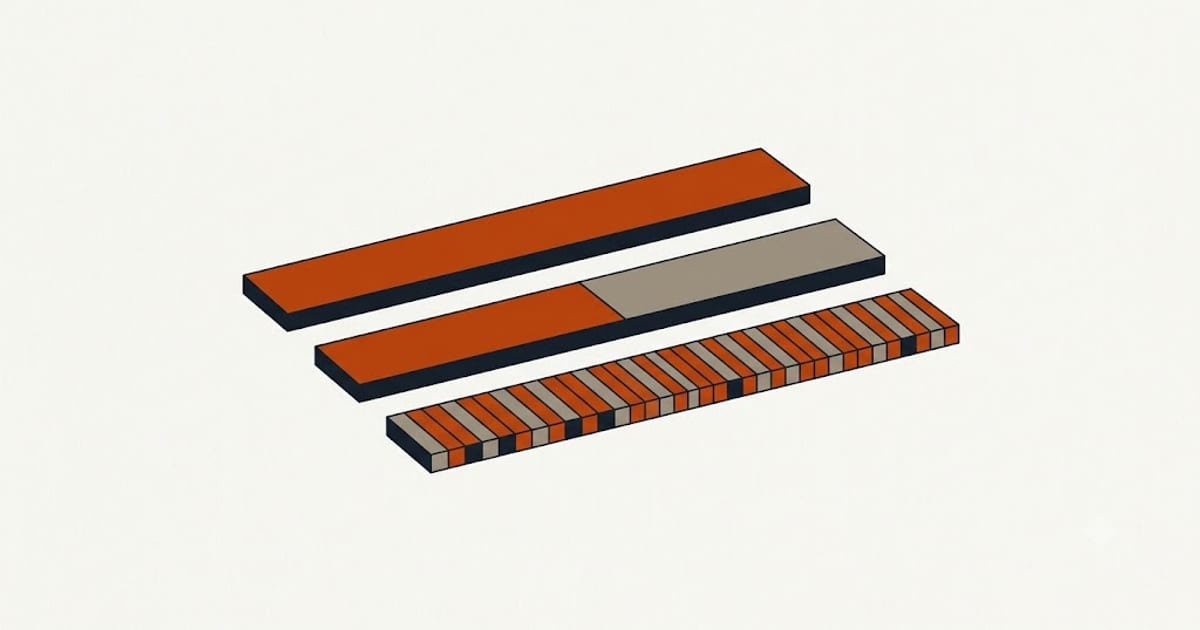
Cooling equipment differs in how finely it can match its output to the load at that moment.
Single-stage
On at 100%, or off. Nothing in between.
Because a house is at design load for only a handful of hours a year, a single-stage system spends nearly its entire life cycling on and off to average out to the load it actually faces.
Cheapest to buy and simplest to service.
Two-stage
A low stage around 65–70% of capacity and a high stage at 100%.
The system runs in low stage most of the time, which means longer cycles, better dehumidification and steadier temperatures, and steps up on the hottest days.
A moderate cost increase for most of the comfort benefit.
Variable-capacity
An inverter-driven compressor that modulates continuously, often from around 25–30% of rating up to 100%.
It finds the output that matches the load and holds it, so on a typical day it runs almost continuously at low output rather than cycling at all.
The most expensive and the largest comfort difference.
What long run times actually deliver
Dehumidification, which is the main one. Moisture removal is a function of run time at a cold coil. Continuous low-output operation removes far more water per day than intermittent full-output operation delivering the same total cooling.
Even temperatures, because air is circulating continuously rather than in bursts.
Quieter operation, since low stage runs the compressor and fan slower.
Better filtration, because air passes through the filter constantly.
Where it is worth the money
Humid climates — the strongest case by a distance. The humidity difference between a single-stage and a variable system in the Southeast is something occupants notice immediately.
Houses with rooms that never even out.
Zoned systems, where the equipment must operate against a partly closed duct system. Variable capacity turns down to match a single zone instead of fighting the dampers.
Where the system is slightly oversized and cannot practically be replaced with something smaller.
Where the case is weaker
Dry climates, where latent load is minimal and there is much less to gain from long run times.
Short cooling seasons, where the running-cost savings have too few hours to accumulate against a substantially higher purchase price.
Rental or short-hold properties, where a longer, more expensive repair path is a liability rather than an investment.
The service consideration
Inverter-driven equipment is more complex. Boards and drives are expensive, and not every local technician is equipped to diagnose them.
Before choosing variable-capacity equipment, it is worth asking who in the area services that brand and what a replacement inverter board costs.
What it does not fix
Variable capacity does not fix undersized or leaky ducts, an absent return upstairs, or a house that has never been air-sealed.
It makes an oversized system behave much better, which is genuinely useful. It does not make a load calculation unnecessary — the modulation range is a percentage of rated capacity, so a badly oversized variable system still has a minimum output above what a mild day requires.
The order remains: calculate the load, correct the ducts, then choose the equipment tier.
Airflow has to keep up
A variable-capacity outdoor unit paired with a fixed-speed blower gives away much of the benefit, because the indoor airflow no longer tracks the output.
The matched indoor unit for this equipment uses an ECM blower that modulates with the compressor, and the AHRI certified combination assumes it. Mixing an inverter condenser onto an old air handler produces a system that is expensive and does not behave the way the brochure describes.
Thermostat compatibility
Two-stage and variable systems need a thermostat that can call for the stages, and inverter equipment frequently requires the manufacturer's own communicating controls rather than a generic smart thermostat.
That is worth knowing before buying a thermostat separately, and worth asking about if a particular thermostat matters to the household.