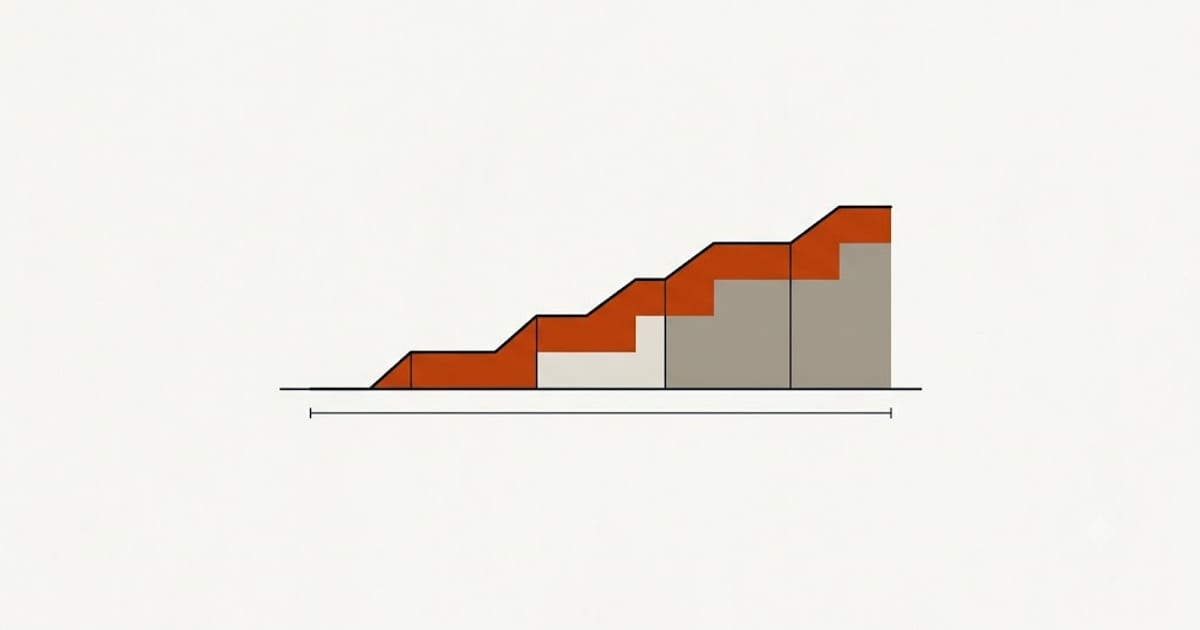
Installed cost rises with capacity, but not in proportion, and understanding the shape of that curve explains a lot about how systems get sized in practice.
What scales and what does not
Equipment cost scales with capacity, roughly, within a product line.
Labour barely scales. Setting a four-ton condenser takes about as long as setting a three-ton one. The line set, the electrical, the pad, the permit, the commissioning — all essentially fixed.
Since labour and the fixed items are commonly half or more of the total, a step up in size changes the total by considerably less than the tonnage ratio suggests.
Why that matters
Going a size larger is cheap on the quote and expensive over fifteen years of humidity problems and short cycling.
A contractor who rounds up faces no meaningful sales resistance and eliminates any risk of a callback saying the system will not keep up. The incentives point one way, and that is the mechanism by which the American housing stock ended up systematically oversized.
Understanding this is the reason to insist on a load calculation rather than accepting the larger option because it costs little more.
What moves the total far more than tonnage
Equipment tier. Single-stage to two-stage to variable-capacity is a much larger cost range than one tonnage step.
Whether the air handler or furnace is included.
Ductwork. Repair, resizing or replacement can rival the equipment cost.
Electrical. A new circuit, or a panel upgrade, on a conversion to a heat pump.
Access. An attic air handler in a tight space costs more in labour than a garage installation.
Line set replacement, particularly when converting from R-22.
Region. Labour rates and permit costs vary widely, and a metro market can be substantially above a rural one for the same work.
The refrigerant transition and price
New residential equipment is moving from R-410A to lower-GWP refrigerants such as R-454B and R-32 under the AIM Act phasedown.
Transitional periods raise prices. Components are not interchangeable between refrigerants, and the practical effect is that the equipment side of a quote is less stable year to year than it has been.
That is a reason to plan a replacement rather than be forced into one, and a reason to ask which refrigerant a quoted system uses.
Reading a per-ton figure
A quote expressed as dollars per ton is a poor comparison tool, precisely because the fixed costs do not scale. A small system will always look expensive per ton and a large one cheap, which says nothing about either quote.
Compare total installed price for a specified matched system, with the same scope, and with the AHRI certified reference number on both.
Where the money is best spent
For most houses, in this order: correct sizing, then duct sealing and correction, then envelope improvements, then equipment tier, then efficiency rating.
The last two are what quotes are usually argued about, and they are the two with the least effect on whether the house is comfortable.
The timing lever
Replacement in the shoulder season — spring or autumn — is generally cheaper and gets more careful work than an emergency replacement in July, when demand is at its peak and the decision is made in a day.
For a system that is old but working, that is an argument for planning the replacement rather than waiting for the failure.
Incentives change the comparison between tiers
Federal tax credits and utility rebates are generally tied to efficiency thresholds and to equipment type rather than to size.
That means an incentive narrows the gap between a base system and a higher tier without changing the gap between a three-ton and a four-ton unit — so it is an argument for a better system, never for a bigger one.
Programme thresholds are stated in SEER2, EER2 and HSPF2, and they are revised annually. Check the qualifying levels for the year of installation rather than the year of quotation.
What a warranty is worth here
Most manufacturers offer a longer parts warranty when the equipment is registered within a set window after installation, often 60 or 90 days.
That registration is frequently the contractor's job and frequently forgotten. It costs nothing and it is worth confirming, because the difference between the base and registered warranty is typically several years on the compressor.